
As I mentioned in an old post, I bought something called the Harmonic Converger. I put the device through its paces and have done my first full-length review of the thing – actually it’s my first full-length review of anything.
I’d like to remind people that I am not affiliated with the creator in any way, nor do I claim that this review be considered as “definitive.” However, through the methods I’ve used to test this device; I am confident that this review, at this point in time, has a fairly accurate representation of a device that ultimately, will remain a mystery to everyone (due to the creator’s secrecy).
If you wish to link to this review with a more user-friendly URL, you may use any of these:
http://www.nargalzius.com/hc
http://www.nargalzius.com/harmonic_converger
http://www.nargalzius.com/hcreview
Goal
The goal of this review is to invite people to have a listen, and hopefully relate to the potential benefits the Harmonic Converger may have on one’s tone. It, in no way, is asserting that people need the HC to solve anything that may (or may not) be existing in their current “setup.”
If you are perfectly happy with your tone, then good for you and you can stop reading now.
If you aren’t, or at least feel that what you’re getting out of your current setup isn’t enough – or at the very least open to the possibility of improving what you already have, then read on.
Once Upon a Time
A few years back, there was a thread in the Line6 messageboard where people were discussing ways of addressing a nagging issue called “fizz” 1 Which will be discussed in even greater detail later in the review that came with tones that use a lot of high-gain distortion (hi-gain).
One of the users then hinted at having developed some home-made circuit which addressed this issue quite effectively. As time went by, people doubted the existence of the said circuit and its “effects.” They had good reason to, as the user never really had any comparison clips to have them listen to… until he posted the following samples below 2 I was lucky enough to download the samples, that old forum is now gone. Also take note that the clips start with the circuits ENGAGED, then switch on and off every so often.
The clips featured two different “circuits” doing two different things. However, one of them clearly solved the major issue of “fizz.” Everyone rejoiced and waited in anticipation for the user to start building and selling units… for a while.
Alas, it was never intended to be a commercial product, hence issues ranging from payment options, customization, cost of parts and the hand-made building of the unit put the price in the $200-$300 range. Anticipation quickly turned into reservation, frustration, and incredulity – as they thought the product was ridiculously overpriced.
One thing led to another, reputations were put into question, egos started flaring up, sides and loyalties were switched – it was a real mess. Yet regardless of who was “right” and “wrong” at that time, there was one clear fact; there did exist a mysterious circuit that can subjectively “improve” tone. Everyone who owned one swore by it, and everyone else continued trying to discredit it.
Those two experimental circuits (and possibly more) have since then been incorporated into a single device – and has been constantly revised/improved over time. 3 At least that’s what he says – we have no way of knowing, really. That device, is what people call the “Harmonic Converger.” (HC)
More Than Meets the Ear
The problem of fizz seemed to be what prompted the creation of the HC. Yet simply calling it a “fizz-killer” doesn’t give justice to the said device. It is claimed to do much more in terms of “tonal transformation,” but for as long as its inventor is unwilling reveal the “secrets” of his circuitry, I guess people relating the unit to fizz alone, would be a harsh reality he’ll have to live with.
The reason why most people focus more on the fizz-killing properties of the HC is simply because it is the most apparent effect that anyone, good ear or bad, can hear and relate to. So for this review, I will certainly try to mention and point out the other benefits and “effects” I [can] hear to the best of my abilities. But do not be surprised if I spend a great deal with discussing fizz, as it is what most people identify with.
What is this “fizz” you speak of?
Inventor Hadley (aka “Radley”) Hockensmith tries to describe this fizz in the Harmonic Converger’s “official” page. He used very subjective words, but I’d be hard-pressed to find a better worded description of the phenomenon. Here’s a passage from the page.
Have you ever noticed that many distortion tones have a bogus-sounding hi end (mosquito-esk), that is seemingly imported from another universe, and sounds totally foreign to the main body of the tone (I call these “orphaned highs”).
In case you still can’t relate to what he’s talking about, try listening to the earlier clip(s) above, where you can hear the “fizz” quite clearly.
It is worth mentioning though, that a lot of people claim the only reason that fizz is present is because people don’t take the time to dial in what they call “good tone.” To address that argument, I’ll have you listen to these two clips below. First is Pantera’s “Walk” from the album “Vulgar Display of Power” and “Yesterday Don’t Mean Shit” from their album “Reinventing the Steel”
Incidentally that fizz-riddled sound the late Dimebag Darrell in the “Walk” sample was present ever since Cowboys from Hell – and persisted up to Far Beyond Driven. In The Great Southern Trendkill, it was somewhat being addressed, and in Reinventing the Steel, it has been greatly [possibly even completely] eliminated (as you notice from the second clip).
In context of those two commercial tones, we can see how the previous argument simply doesn’t hold any water. Both are awesome tones, that’s why they made it to the store shelves. The point of comparing these clips was not to say that one patch was better than the other but simply to prove that fizz is not a function of good or bad tone.
I guess at this point, it’s safe to say that we have established beyond any doubt, that the concept of fizz is real and present, and that anyone who claims otherwise is either of three things:
-
They can’t hear it A number of reasons could contribute to this – ranging from really stupid to perfectly legitimate.
The stupid scenarios include the person being “deaf” (figuratively), or that they simply are too used to the sound already. The latter is specifically annoying because it’s thinking like that which allows corruption in governments to remain – because it’s been there since the beginning, so might as well get used to it.
The legitimate scenario would be they have other gear in their signal chain that already masks out the fizz naturally (e.g. having a nice tube amp and speaker cabinet), or that the type of music they play simply doesn’t require them to dial-in tones that are prone to fizz.
-
They enjoy the sound of fizz I’m not being sarcastic here, there are instances where fizz is ideal. Personally, I would’ve wanted Lenny Kravitz’ “Are You Gonna Go My Way” to have fizz (it doesn’t, FYI). I think fizz would lend well to that type of “feel” of the song.
- They’re too stubborn to admit it We can’t deny the fact that we’ve spent quite a penny for our gear. So someone coming up claiming that our gear has some serious issue will certainly make for a hostile defensive argument. However, not everyone can draw the line between a legitimate defensive argument or mere fanboy-ism. I love my GT-8 as much as the next person, but I’ll be the first to admit its limitations – same goes for any other thing I own.
There’s no point in trying to convince yourself to feel good about spending on something that’s far from perfect when that simply isn’t the case. Nothing in this world will be ever be perfect – deal with it!
Fizz is real, and wherever it exists, most of the time, is a serious issue – and if you’re a person who doesn’t like it (I know I don’t), then this review is for you.
The Art of Killing Fizz
Allow me to save time on a lot of future debate by saying straight out that as far as fizz goes, 4 Take note I said AS FAR AS FIZZ GOES – because it would be tragic if you would dismiss the HC simply because you thought it was a mere fizz-killing device. nobody really needs the HC – or any other 3rd party solution for that matter. The fact that the Pantera clips weren’t using an HC already proves that point that it can be done without it. When using multi-effects (multi-fx) processors, you can certainly achieve a fizz-free tone a number of ways through commonly available resources – if you would only spend the time to do so.
However, for most us who use “less than the best” equipment, it’s my opinion that in most cases, a bunch of these approaches are “workarounds” – real effective workarounds at that. Still, wouldn’t it be nice to not have to work around anything? Here are examples of “solutions” that I’ve heard people suggest, and my opinion regarding them:
-
You can try EQing the fizz into oblivion. A tried and tested method. However instead of the EQ being used to really sculpt your tone, you end up using it to notch out the offending fizz frequencies (and possibly compromising the overall “tonal effectiveness” of your patch in the process).
What if you only got 3 bands to work with on that EQ, and your fizz lives in multiple areas of the spectrum? Not only have you used up your EQ just for that, but you can’t even eliminate it completely, let alone further sculpt your tone with it.
-
Use some clever phase-related trickery via a chorus effect. I’ve heard people swear by this, and I’m happy for them, but the chorus by nature wasn’t intended to address such issues. Instead of the chorus being available to you for a more useful purpose, you’ll use it as some sort of sonic band-aid.
-
Turn down the gain. Sure, that works as well – at the expense of sacrificed sustain (among others).
The most important point though is that hi-gain is hi-gain. If you cut down on that gain, then it defeats the purpose of a “hi-gain” patch don’t you think? You can try your best, but there’s really no substitute for true hi-gain.
- Try different cabinet/speaker/mic sim combinations Sure, you can definitely use combinations that produce the least amount [or if you’re lucky, none] of that fizz.
You should realize by now how much you’ve limited the options available to you. You’re essentially choosing your combinations based on avoiding fizz, instead of actually finding the tone you like.
There’s even one “non effects-based” solution, which is to ultimately run your rig through some solid-performing hardware at the end of the chain; like a real tube-amp and proper cabinets. These literally color the sound in a good way (and can probably eliminate the fizz naturally). But aside from costing a lot, it’s too cumbersome a setup. You’d have to have that rig handy all the time to get your ideal tone – which is probably a luxury only the rich and famous can enjoy.
You can do a combination of any [or all] of the above mentioned – or add even more effects to help out. The more effects you use and tweak, you certainly have a better chance of eliminating most, if not all fizz – but just think of how many “soldiers” (effects) you had to sacrifice just to deal with that single issue. What if other issues popup at the latter stages of your tone-searching; you got more of those effects handy to deal with those? Hence my point that these are “workarounds” at best. The same argument stands with whatever effect “workaround” you can muster up.
Truth of the matter is, if there was a way to be able to eliminate hi-gain distortion’s propensity for “fizz” without having to sacrifice your other tone-shaping tools for that single annoying purpose, then everyone would be happy – and we wouldn’t be having this discussion. However, this seems to be an area where digital effects processors seem to fall short – and is precisely the area where the HC shines.
The Harmonic Converger
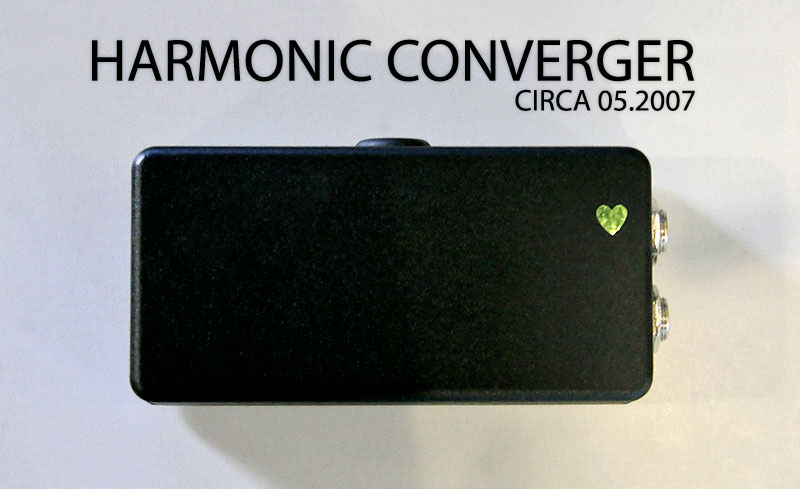
I had a custom built mono HC which was made to work either on a loop or stereo (headphone) out. The only drawback I can see from this request is that while my HC it can take stereo (headphone) input, it will always output in mono (it just chooses and uses one channel). It was primarily designed to be used with loop circuitry, and the customization to accomodate the headphones was just a bonus request in case I wanted to try it with other gear. Since it was in mono, for me to get “stereo” effects while using the HC, the loop’s location in the effects chain must be before all stereo effects.
The FAQ 5 Frequently Asked Questions section of Radley’s Corner had this to say about it:
Q:Because the Loop HC is mono, does this mean I cannot use my GT8’s “stereo amp” feature?
A:Not at all – you just have to use a somewhat different approach: Position the Loop/HC in-between the OD and the Amp models in the GT chain, then select a distortion source from one of the many excellent GT OD/Dist models. Now you can select any two clean (or semi-clean) GT amp models for left and right channels, along with different Cabs, Mics, as well as the dual amp delay setting – Phat City! ;o) Because the GT’s OD/Dist model is the primary distortion source, the HC can add it’s magic before the stereo amps split to discreet stereo – this setup offers a huge amount of tonal flexibility and EQ, and is my main source of Solo tones.
Package Contents
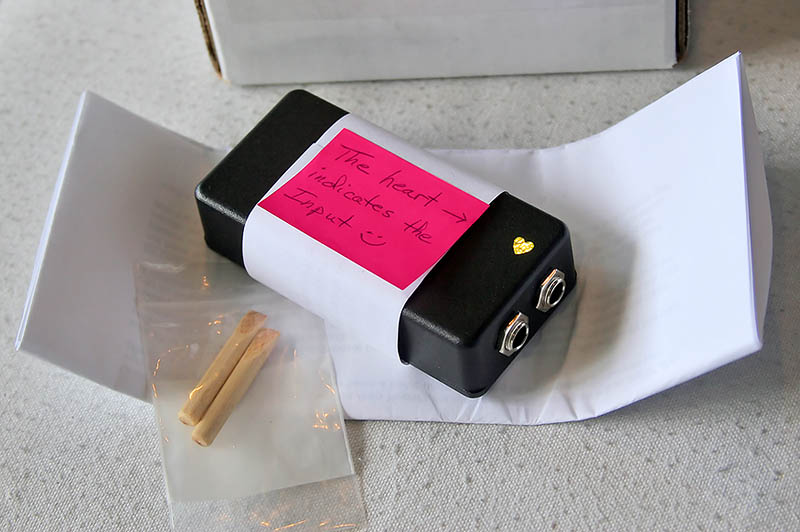
It came in a box that was pretty inconspicuous and unassuming. Opening it revealed the following:
-
Harmonic Converger
I’m not quite sure when exactly Mr. Hockensmith started building HCs that looked like this, but I really think this design is a winner. -
Special adjustment tool (2pcs)
Basically, it’s just a wooden wedge (for lack of a better term). I do agree though that it was prudent to include such a tool, since it’s non-conductive and as the creator claims, will not strain the internal components as when you use metal tools with it. - Documentation
A “manual” if you will. It basically tells what the product is, what it does, why it was created, and how to effectively use it. Naturally, there’s no indication of any technical details because of the creator’s “secrecy.” Also, a piece of paper that notifies the user of the exisence of the said “adjustment tool.” In my case, there was also a little post-it note reminding me what the heart-shaped sticker was for.
Inspecting the HC
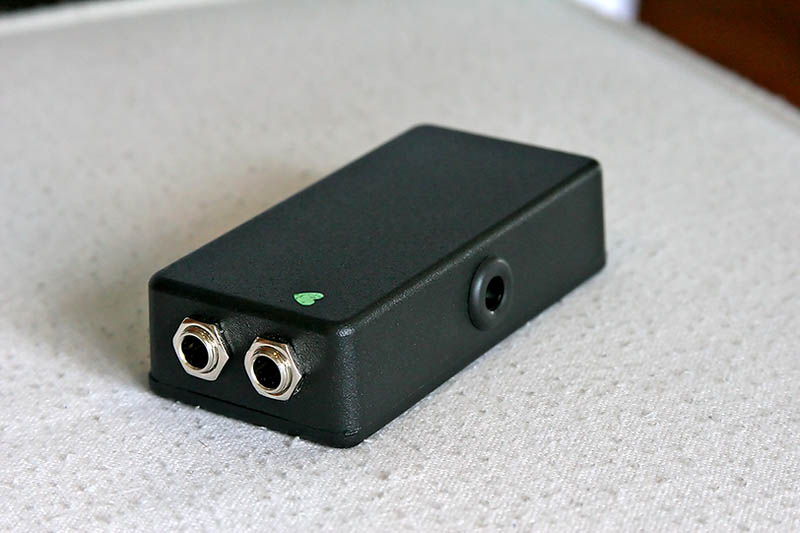
The unit itself is built like a tank. As you can see, it has come a long way since its initial physical design. It’s kind of hard to describe how impressive the built quality the HC has; the quality of the materials that were used. You really have to be holding one to know what I mean, but I’ll try anyways.
For its outer shell, you have a black metal casing with approximate dimensions of 10cm x 5cm x 2.5cm. This shot of the HC’s backside may give you an idea on the “texture” of metal container. The backside also shows the 4 phillips screws that join the bottom plate and upper “container” together.
Don’t get any ideas of opening it up though; the HC’s innards have been filled with epoxy. If you try opening it, chances are you’ll break it and end up with a $200+ paperweight, and that’s as “passive” as the HC can ever get 😉
The casing feels feels really thick and hard when you tap/flick it with your fingernails, (or maybe it’s because of the epoxy inside). Either way, Mr. Hockensmith wasn’t kidding when he said the thing is “overbuilt.”
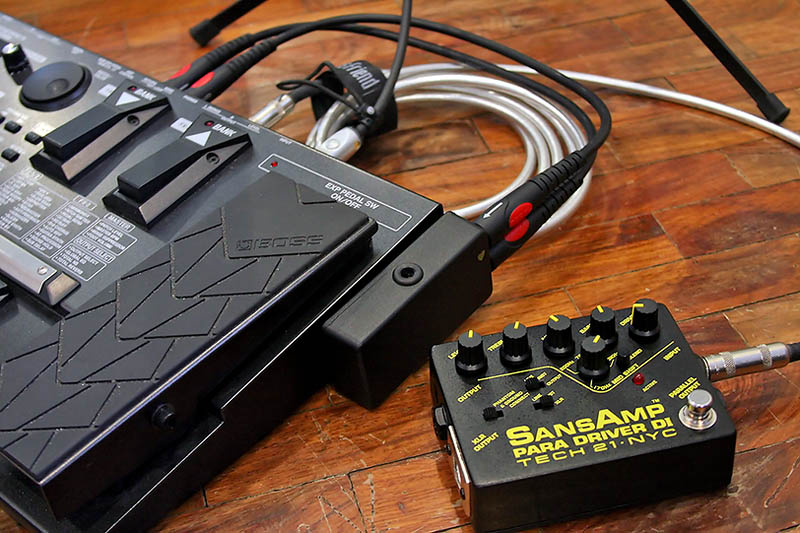
As I said earlier, my model was a mono loop/headphone hybrid (but leaning more on the loop side of things) So I have two 1/4″ jacks on the same side. The reason I requested the in/out to be on the same side was to make it easier to hook it up to the GT-8’s fx-loop (as you can see on the image on the right). It had that little heart-shaped sticker to indicate the input jack. A lot of people chuckled at it, but I think it’s appropriate; it’s like saying “this is where all the love starts!” In the event the sticker is removed, I simply made a mental note that the input is on the same side as the drive adjustment pot. 6 Potentiometer
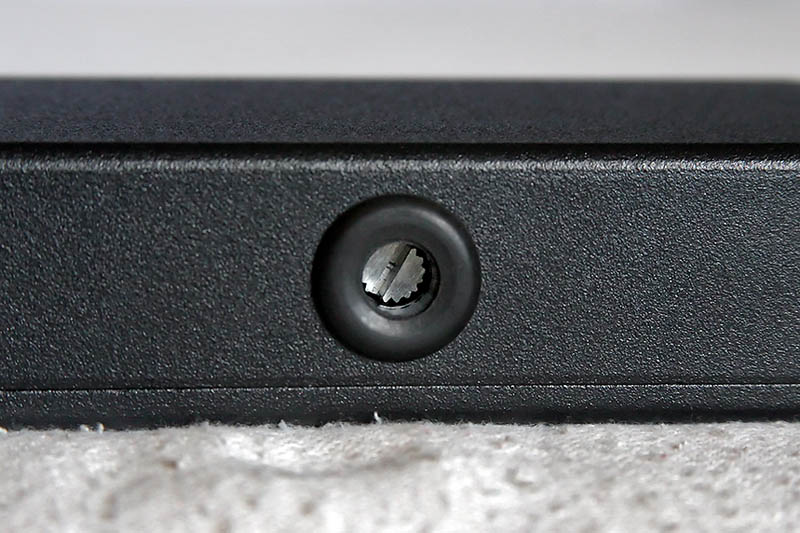
The drive adjustment pot is basically a recessed area with a rubber frame/guard. The pot is located deep inside which can be adjusted by the supplied “adjustment tool.” Unlike the initial design, which used a switch of 3 levels (normal/bright/dark), you can now control an incremental value of how much of the effect is applied. Starting from a bypass (fully turned counter-clockwise) to increasing amount of effect as you turn the pot clockwise.
The “groove” in the pot (which the adjustment tool, adjusts) has been placed in such a way that you have an indication at what level effect you’re on. The bypass is roughly about a 30° tilt from the bottom center going to the left. While the maximum effect is about the same degree of tilt, but going to the right instead.
When trying to turn the pot, I can’t help but be impressed on how smooth it turns. I mean you guys must be thinking “it’s a friggin’ potentiometer! Just like your guitar knobs, of course it would turn smoothly the same way!” This is true, but you have to understand, for anyone who sees (and holds) the HC for the first time, you have to admit that it’s basically a slab of metal with 2 jacks and some turn-thingie which looks like a screw – having that lone movable part perform like a swiss watch is certainly a welcome surprise.
So from the physical attributes of this passive device, you can sort of already feel the level of professionalism put into building it. His openness to change his initial design based on user input shows his commitment to making a device that everyone would appreciate. His filling the unit with epoxy hit’s multiple birds with one stone.
- He gets to retain the secrecy of his circuitry.
- It acts like a big heatsink.
- It makes sure there’s no other moving part aside from the drive adjustment pot.
“Overbuilt” is certainly an apt description of the HC – which is always a good thing – especially if you spent more than 200 dollars on it.
He even goes further with the documentation; he tells how to effectively use it, what not to use it with, things to do and avoid, etc. Even his stand on using the wooden adjustment tool reflects the care he puts into his creations. Honestly, if you ask me, I think it’s ok to use a screwdriver as long as you’re careful – in fact you probably don’t even have to be careful. Yet he advises you to not even try (using metal objects) just to be on the safe side, and that is a sensibility I truly appreciate. Better to cover all the bases, because most people aren’t as prudent as we’d all like them to be 🙂
The HC may or may not be hard to build (that will forever be a mystery), but either way, the level of quality in each (based on the unit I got) is a testament to Mr. Hockensmith’s commitment on giving each customer a flawless unit that’s up to the strictest of [his] standards. 7 And from what I’m seeing, it seems to be pretty high 🙂
Now that we’re done with the whole “first impressions” bit, lets get right down to the meat of the issue. Lets see how the HC performs…
Show me the money!
Here’s what everyone’s been waiting for… audio clips! Below is the signal path I used to generate the sample clips with. It may not be much, but it does the job. I’ve made many a song with it already and it has never failed me yet.
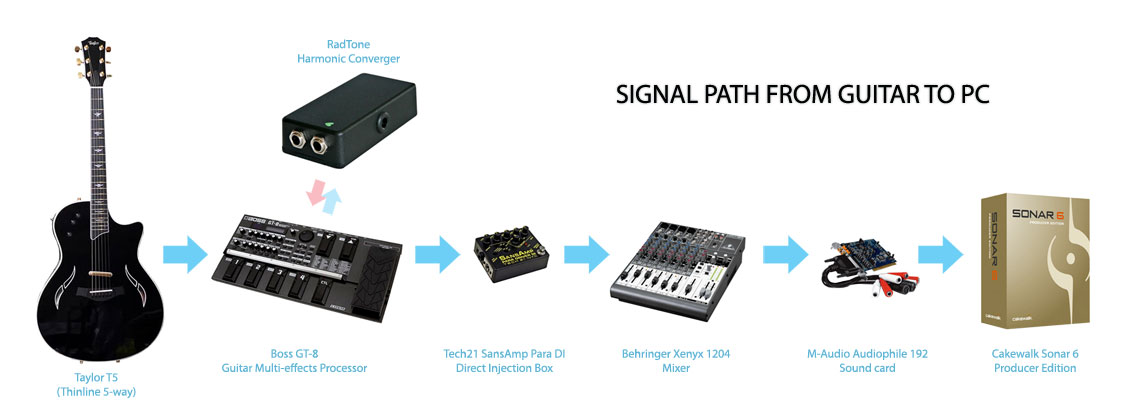
Since the HC is most known for its fizz-killing attributes, then I thought it would be a good idea to run the fizzy Pantera clip through the HC both via stereo out and through the fx-loop.
So for the first batch of samples, here’s what I did to prepare the “commerical clips”:
- Rip a lossless copy of that intro from my “Vulgar Display of Power” CD
- Take one channel (I chose the right) to retain a mono signal; because merging the two channels together might cause some phase-related issues – and because my HC model works in mono.
- Edit the intro in such a way that it loops for a considerable amount of time.
- Plug that edited lossless wav file into my iPod and use it as a source to test the HC with.
All the clips you will hear however, are MP3 files. Before you can complain about wanting lossless audio, let me assure you, you will still hear what you need to hear. 8 Just make sure you’re listening through good speakers or cans I can really go into detail about all this “audio compression” business, but let’s just save it for another time shall we? I know my audio, and if you don’t trust me on that, then just stop reading now.
First, let’s establish the formalities, this clip you’re going to listen to is the intro without the HC engaged. The significance of this clip, is that I alternated each “pulse” from 3 different sources of the same material, namely:
- Direct import of the ripped WAV file into the audio software.
- Through GT-8’s effects loop (fx-loop)
- iPod headphone out direct to HC
The purpose of this clip to test the neutrality/transparency of each “source” and establish that there is minimal or no coloration by the mixer, DI box, or GT-8 (with all effects off) Have a listen to the clip yourself – it’s going to be last time you probably need to do so.
One method of sampling I think people would appreciate is if I’d turn the HC’s drive adjustment pot from bypass to maximum blend, and essentially sweep though the whole range the HC’s pot. This should make people hear the HC affecting the tone with all possible “values,” allowing them to make a more informed inference as to how the HC might be useful to them.
Notice that the starting volume on the second sample is softer, this is because the HC is more “sensitive” when used directly from a stereo/headphone out, so the effect is more pronounced. The initial recording clipped, so I adjusted it accordingly.
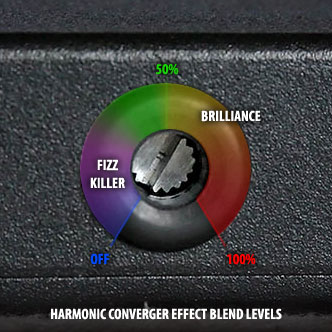
It is worth noting though that the abrupt changes in the sound on the first stages of the “sweep clips” were not because I turned the pot too fast. Based on what I was hearing, the image on the right is something I whipped up that summarizes what my HC seemed to be doing as I swept though the pot:
It is good to mention at this point that everything below is my opinion and mine alone. The circuitry and processes the HC uses is a mystery to all but its creator – so we can only hope to “interpret” them as best as our ears can hear, and as best as our words can articulate. So I will attempt to describe the effects of the HC in context of my limited knowledge on the device, and the sample audio clip used.
The blue and purple area represents what I call “fizz-killer” section. This is where most of the timbre change happens – and those changes seemed to be specifically targeted to eliminating fizz. It’s a pretty narrow area; and once you enter the green area, fizz is virtually eliminated completely at that point and begins to brighten the resulting sound (hence my dubbing it the “brilliance” area).
At that point, from what I’m hearing, the new “fundamental tone” 9 As a result of having gone through the “fizz-killer” section. doesn’t change anymore – it simply adds “bite” to it. Other HC owners use words like presence, snarl, and urgency to describe the effect, but I think we’re all referring to the same effect of adding “brilliance” to the tone.
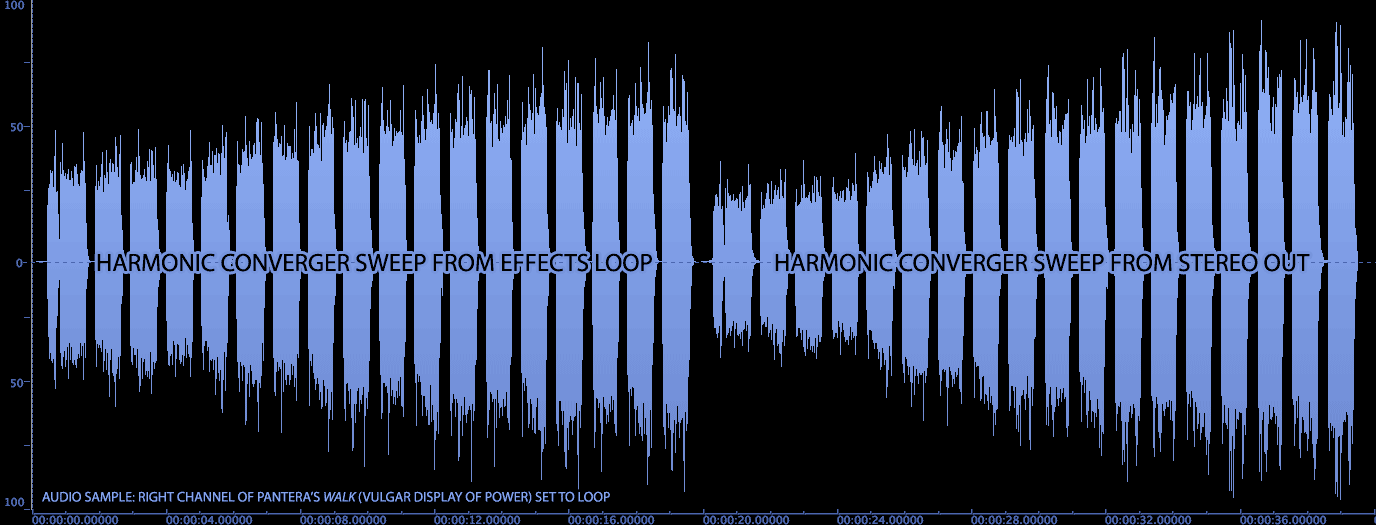
Once you go beyond 50%, it gets even brighter. The higher you go, the less changes you’re likely to notice – but be assured that your tone is still being affected, as seen in the the waveforms to your right. The stereo-out method’s overall “brightness effect” is more pronounced. So a 50% on the fx-loop is more or less the same as being between the purple and green areas when in the stereo out (35-40%?). Also, once you go higher, it gets waaaay brighter than if you were in a normal fx-loop mode.
Overall, the green area is what I would consider to be ideal for most uses. It has fizz completely eliminated, and is able to put back some highs that were possibly lost in the fizz-killing process. Anything above that (yellow to red) is already obnoxiously bright IMHO – though some people might prefer that. The question that I keep asking myself is if those differences actually matter at the upper register of the drive pot (yellow to red). I honestly can’t imagine anyone wanting to use a setting above 50% (probably 40% on a stereo out).
Eventually, Mr. Hockensmith explained why the drive adjustment pot was designed that way:
Keep in mind that the HC’s Blend control is intentionally “overdesigned” – the extra brightness is needed in some cases when the impedance is less than ideal. Plus you actually get a bit more HC effect by running the blend higher and reducing the highs on the modedler – I usually recommend starting at 50%.
This point is further discussed in the FAQ section of Radley’s Corner.
Before that explanation came (the FAQ was just recently updated. A lot of the new points, I’m quite certain, were added in light of this review), I didn’t discount the possibility that perhaps the sample I used wasn’t the best candidate to show how the HC affects those ranges, because I’ve heard reviews where some users claim that they like having it at 100%. From what I’m hearing, you can possibly utilize those upper ranges of the HC pot properly if you start with a relatively fat tone.
To test that theory out, I pulled out a patch I made that had sort of a round tone (instead of the usual “scooped” hi-gain metal tones people like). It’s the guitar sound I used for a song I have in the works:
Isolating that same tone, I tried to do a sweep on it as well, but only through the fx-loop. It has already been established earlier that the effect of the HC is more pronounced coming from a stereo out, so it would be a waste of time and effort to have to prepare clips for each and every different audio sample just to reiterate what we already know.
For this clip, I killed the phaser and reverb on the patch so it would be easier to hear the HC’s effect. Notice that even with the HC on 100% blend, the tone is still quite tolerable – which basically proves that the HC’s effect will depend on the tone you throw at it. I feel it is important to reiterate this point:
The HC’s effect will depend on the tone you throw at it.
Just so you guys could have more clips to absorb, I did the guitar part of my song earlier. The first pass is the original sound as you hear it in the mix (just played a bit differently to hear more palmed chords), the second is running it through the HC at 50% and tweaking the EQ a bit to compensate for the added brightness.
The nice thing about this clip is that the source sound has minimal or no fizz to begin with. One of Mr. Hockensmith’s frustrations is that people dismiss the HC as a simple “fizz-killer” – and base their purchasing decisions on that premise. If you don’t have fizz, it doesn’t necessarily mean that the HC has nothing else to offer you. This clip proves that point to a certain extent.
Notice how the individual notes on the second pass have more definition compared to the first – especially on the first three chords (the first 9th on the F, the second regular G power chord, and the C9/A) – and the last open Am. There’s also the inherent addition of the “bite”/brilliance we were talking about earlier which allows these chords to be as defined as they are.
Next, we have the the other extreme people want to know about – how the HC affects super-clean tone. But before we get into that, it’s worth mentioning that the HC was never designed for these types of tones. The HC was built for electric guitar tones (e.g. clean electric, overdriven, etc). The logic behind this is the same reason why you simply don’t plug in an acoustic guitar on an electric guitar amp. This is all discussed as well in one of the FAQs in Radley’s Corner.
However, I felt I needed to include this clip is because there are electric guitars that have acoustic guitar tones. My Taylor T5, which is an electric guitar by nature, is such an instrument. Same holds true for a Line-6 Variax, or similar guitars. Hell, even most multi-fx modelers have patches that simulate acoustic guitar tones nowadays. So for people who do need those types of tones, here are the implications of running your modeler through the HC. This small “exception to the rule” becomes a legitimate concern once you consider using a stereo HC, because normally, you couldn’t “disable” it. 10 Unless you find some sick joy in constantly turning that drive pot whenever you switch patches. Or if you want to try putting a stereo HC on an fx-loop – it will probably work, but not as efficiently, as proven in the HC Test Drive.
What I did was just use a clean patch I made for the T5, strummed a G chord three times, each time having different HC levels applied (bypass, 50%, 100%). This was the result.
In this case, it performed like a simple cabinet emulator or amp simulator (e.g. SansAmp, etc.). Obviously, the HC has nothing to contribute for people who include these types of tones in their setup – which is why I think it is best to be put in the fx-loop and have it only effect electric tones (this includes clean electric tones). I will discuss this point in detail later in the review. For now, suffice to say, that if you “live” in these types of tones, chances are you won’t be able to enjoy the HC’s benefits much unless you have a way of disabling it.
The next clips are kinda redundant to all the other HC review clips we’ve all found floating around the internet – it focuses on hi-gain. I included it here for posterity’s sake. I do have some points to share as well however, after you have listened to them.
Here are some samples based on a “Metallica” patch I found floating in BossGTCentral a few years back. It features a phrase I played 5 times, using 5 different settings I did on that very same patch. Namely:
- Adjusted to kill fizz – hi-freq cutoff set at 4KHz
- hi-freq cutoff set at 3KHz
- hi-freq cutoff disabled
- HC enabled, EQ adjusted to compensate for being overly bright. hi-freq cutoff disabled
- Same settings as #4, with the HC bypassed.
Now, the point of these samples was to address the whole high-frequency cutoff/rolloff people say the HC does. They often dismiss it as a simple EQ filter (an LPF 11 Low Pass Filter to be precise) but hopefully these clips will put that notion to rest. The first pass, for all intents and purposes is pretty decent already. I just did the 3/8KHz rolloff adjustments to show how a “LPF” would probably work when applied or bypassed. The 4th pass shows how the HC performs when optimized for the fundamental tone. Again, the “quality” of the tone is determined by how good the person dialing-in tones is. I’m not arrogant as to assume if this tone I made is good or not – but the fact remains that if you compare the 1st and 4th, both of which are “optimized” for use with and without the HC, you have to agree that while both are pretty decent for the purposes of the review, the HC enabled pass still sounds more “amp-like.”
While the HC does a cutoff/rolloff the upper range of frequencies, it does those adjustments in a tasteful and musical manner. Should the comparison be made, it’s much smarter than an EQ filter.
The last clip would be what everyone already heard in the past; stock patches used with the HC bypassed and on. The clip I chose was a patch called “Natural Speed” from the GT-8 stock patches. I did no adjustments whatsoever (save for positioning the fx-loop right before the EQ. I did 3 passes, one with the stock sound, one with the HC @ 50%, and one with an “HC optimized tone.” For now, don’t listen to the last pass because I will have you listen to it in context of a point I will try to make.
Listen to the clip below
So as we all know, stock sounds usually suck. And we know that while the HC tries its best to fix most of the problems that may be present in a hi-gain tone, it cannot miraculously turn a crappy sound into gold. So the first two passes both sound crappy. The first had fizz and whatnot, the second had no fizz, but was obnoxiously bright. Now the 3rd pass, I will not claim to be the “right” sound, but it’s in the ballpark of what most people would probably prefer. It’s doesn’t have fizz, and it’s not obnoxiously bright.
Having said that, I have one simple question: Given the 1st and 2nd pass, which would be easier to “adjust” to reach the 3rd pass sound?
If you’re really good at dialing-in sound, maybe you could match the 3rd, but how much of the EQ would you have to fiddle with? If the EQ wasn’t enough, how much more effort would you probably have to invest to make this patch “useable?” Change amp/cab/distortion combinations? Sure. Change mic placements? Go right ahead. Do whatever the hell you need to take out that fizz, optimize the mids and make it sound more amp-like with whatever tricks you have up your sleeve.
I on the other hand, for the third pass, simply increased the hi-freq cutoff a bit. That was it! It killed the fizz, it made it more amp-sounding, and while it’s not as bright, it isn’t as dull or anemic as when you do a high-freq EQ adjustment without the HC. So the point to be taken home and pondered upon is this:
The HC makes it easier for anyone to achieve an ideal tone.
While it is good that people be “trained” in the intricacies of creating good patches, we are musicians first and foremost, not engineers. Our time is better spent making music instead of adjusting tone.
This bit was done after the review was made. But I felt compelled to let people know about it.
I noticed something significant while playing with the HC; most, if not all the overdrive/distortion (OD/DIST) effects are now “useable” at maximum gain. Normally, you’d have to either back off the gain, use it in conjunction with a preamp setting, or do some heavy EQing to have some palatable OD/DIST sounds.
I recorded each and every one of them, enabling the HC at the second half of each pass. I even threw in a mechanical voice to tell which OD/DIST type is being used. The last three (without vocal prompts) are the 3 last “custom” types. All other effects were disabled save for the Noise Suppressor (and of course the loop circuitry). Bottom, Tone, and Direct Level were all set at 0. Gain was set at maximum (120). And only the Effect Level was adjusted to prevent clipping. HC was set at about 1 o’clock (about 60%).
Listen to the uber-clip below.
May I remind people that this was a simple on/off of the HC with a given setting. You still will have to fine-tune the OD/DIST settings to get a better sound. But I’m sure you can hear my point that the HC puts “new” life into OD/DISTs that you once thought were unusable (because of the inherent fizz). By simply enabling the HC on typical/default OD/DIST settings you can already imagine how much less tweaking is needed to get the tone you want.
Subjectivity
Again, it’s time for the usual reminder that the point of this review was never intended to be about good or bad tone in general. I hope that people listen to how the HC affects the tone. Quite honestly, the audio samples you can find from the web (e.g. HC Test Drive, etc.) are really enough – if you just know what to listen for, you can determine whether or not the HC may be useful to you.
We all have functioning ears and brains. If we can only get over our egos, I’m sure anybody can notice how the HC can be a useful tool based on what it does. I mean there is such as thing as an LPF, possibly one of the simplest forms of “effects/filters” out there – and there are people who have uses for those. Here we have the HC which obviously does much more to the sound than what any simple filter can do. Having stated the obvious, why is it that people find it so difficult to accept the possibilties and potential the HC can bring? It truly boggles the mind.
It’s very true that most people who finally get the HC would much rather make music than talk about it in detail. The reason why I’m taking the time to do this is because I felt that Mr. Hockensmith’s efforts have not only been greatly-underappreciated by the people he wanted to help, but has been subject to unreasonable scrutiny and defamation which he does not deserve. Call me a man of fierce principles, but in my own little way, I wanted to help “correct” this injustice.
The price of the HC is steep, but he has a money-back guarantee on the thing, so I can’t see why anyone would complain. If you feel that you’ve just wasted your money, then return it – simple as that. Its unbelievable how people even consider the “secrecy” surrounding his circuit as a “fault”; he has every right to not disclose details on his creation. It’s his circuit, he can do whatever the hell he want’s with it. If you don’t appreciate it, them fu**ing make your own!
Bascially, all negative arguments I’ve ever heard, read, and seen can easily be distilled to simple sour-graping – because other than that, I fail to see any scenario where anyone would be “justified” to criticize him the way they’ve been doing. It’s one thing to be skeptical, unconvinced even – but a whole other thing to pontificate at the expense of a well-meaning person’s reputation.
Anyways, we digress. Lets get back on topic and now discuss how to maximize the use of your HC. The next sections may branch out and discuss broad topics that are not related to the HC, but I feel that these needed to be discussed so people can have a better grasp of things once you talk in context of the HC. You can think of them as stating postulates in Mathematics… before you get into the topic of “proving.”
Loop or Stereo Out?
The HC, exluding any customization requests, usually comes in two flavors. A loop and a stereo out version. There are valid situations that require the need for each, all of which is explained in the FAQ section of Radley’s Corner
I however, feel that devices like the HC are always better in an fx-loop. But to understand the value of the loop, one must understand the value of the effects chain.
The Importance of the Effects Chain
Some people may think that effects location in a signal path is a trivial thing. It is not, the locations of your effects in relation to each other can make a world of difference. Let me demonstrate (and these demonstration clips have nothing to do with the HC):
That clip has the Whammy (or Pitch Bend) effect somewhere at the end of the chain; which was only choice I had when I was still using an old Digitech RP-10 way back. For some reason, the effect was located at the latter part of the chain, and every patch I used (distorted or otherwise) had that dead-giveaway digitally processed sound when using the Whammy. Here’s the effects chain of the RP-10 in case anyone’s interested.
Now if you would buy a newer model multi-fx processor by Digitech (and I guess all the other brands as well), you’ll notice that such an effect, if available, is now located somewhere in the beginning of the chain (here’s the schematic for that). With the Whammy in such a location, the overall tone would sound like this:
So, to reiterate, location of effects in your signal path can make a world of difference.
For manufacturers who use fixed effects order in their pedalboards, the importance of knowing what the optimum arrangement of effects is very important. And while there may be an unspoken consensus for the most part (like how reverbs always go last), there are still varying opinions on the subject matter. Take for example the Line6 XT Live and compare its effects chain to the Digitech GNX4 mentioned above; the location of their compressors and gates (among other things) are radically different. 12 In all honesty, I prefer the Line6’s compressor location over the Digitech, but I prefer the GNX4’s gate location over the XT Live.
Incidentally, this issue/concern doesn’t apply to GT-8 users because we can set our own effects chain order. 13 Incidentally, that was the feature that made me choose the GT-8 over the XTL.
Now that the importance of the effects chain has been established, then naturally it stands to reason that if you plan to put any other effect in your chain, most of the time, you’d probably not want it at the end of everything – and this will also be clarified in the paragraphs below.
Why the Loop?
2 simple reasons
- You won’t be coloring effects that [usually] prefer not to be colored. These are your delays, reverbs, etc. – which are ideally last in the fx-chain.
- Because you can disengage the HC easily if needed – at least that’s how it is with the GT-8 (just make a patch that doesn’t have the loop enabled).
With the HC on a stereo out, you don’t get these benefits at all. It will be the last and constant thing that colors your tone. Whether that’s a good or bad thing, I’ll leave for you to decide.
Loop HC and FRFR – a match made in heaven
Here’s something to think about; the reason(s) why dialing-in tones optimized for FRFR 14 Full-Range, Flat-Response is useful:
If you want to record with the least amount of generation loss (or least amount of noise), you want to take the shortest path you can take to the mixer. If it’s possible to go directly, then that would be awesome. The reason people still mic amps and speakers instead of going in hot is precisely because the tones direct from their multi-fx lack the warmth, saturation, and urgency (due to the excitation of the strings) than when running them through a live rig (tube amps, etc.). The HC can bring a lot of that warmth, saturation, and urgency without having to go through all of those.
Having stated the above, when recording through “live rigs,” the biggest problem is if the studio has the equipment that you need to achieve that tone. If it doesn’t have the stuff you need, either you bring it yourself, our have them rent it. Again, with the HC, you eliminate most of those logistical problems.
Of course, recording through live rigs still has its benefits (e.g. excitation of the strings through a loudspeaker), so that method won’t be going away ever. Having said that though; all studios have got at least keyboard amps, and those things don’t have the usual “colorization” that guitar tube-amps (or whatever) bring – they are essentially FRFR “amp/speakers” as well. With the HC, you can use a keyboard amp (hell, even some studio monitors) as your loudspeaker, and have the former handle all the “amp-isms,” or “tube-isms” that you need for your tone. And like the acoustic clip you heard above, you can even switch to such tones without having to change amps/speakers to accommodate the highs which electric gutar amps/speakers cannot represent.
Same argument applies to live performances. Live venues will more often than not, have less than ideal guitar amps for the aspiring musician. You can’t expect a venue to have this or that particular amp which this or that particular “performer” prefers to use with their tone – unless of course you’re rich and famous (which means that you’ll probably be bringing the equipment you need yourself) For the aspiring performer however, either you bring the stuff you need, or just work with what you have.
But guess what! If there’s one thing most if not all venues have, is a PA system – you have your FRFR input right there for the taking! Just have a parallel output to some any amp near you so you can hear yourself, and if the sound engineer is doing a good job, you could be confident that what your audience hears is that nice warm, saturated, analog feel the HC has given you.
Lastly, it’s easier to adjust tones wherever you are. You don’t need to run your effects through that favorite speaker of yours whenever you feel like experimenting on your sound. Just bring a set good headphones (again, an FRFR setup) and dial-away. You can probably even do that while your wife is sleeping next to you LOL!
So we’ve established all the benefits FRFR has when you want to have a really well-rounded portable tone. 15 Plus, you don’t have a choice if you want to have authentic acoustic tones in your arsenal. Naturally, a HC in the fx-loop is the best way to maximize its usefulness for your FRFR rig. 16 Which will probably only be comprised of your guitar, pick, effects, HC, and cables 😉 – how’s that for portability!
Impressions
To wrap up, let me share my more personal thoughts on the HC.
I’m utterly impressed by this little thing. It performs as advertised, it looks so sexy, and it’s built like a tank – pretty much high-quality all around.
I was ecstatic once I actually heard the result with my own ears. I’ve been contemplating on buying the HC ever since I got the GT-8, which was a couple of years ago, and been reading up on it to see if it was really worth shelling out money for. I was able to get the tone I like with some post-processing in the computer (when recording), which made me forget about the HC for a while. But once you have more stuff happening in your music, more software plugins or synths being used, you can easily hit a brick wall once your computer starts hiccuping because of the load. So I eventually decided to bite the bullet and spend on the HC, and I can say is that once get to use one, you’ll realize that it was an investment that was worth every penny.
The great thing about the HC is how it transforms your tone to sound like it’s going through legitimate analog gear – it doesn’t sound digital at all. I particularly could appreciate this because I like recording directly to my PC, and getting that warm analog saturation directly to my box without having to post-process anything through software is a godsend.
I guess if I were to create a general truth I noticed about the HC, it would be this:
As far as distortion goes, using the HC will make it easier for anyone to come close to achieving their desired tone. I’ll even go out on a limb here and state this as a fact. While you may not need the HC, if you like distortion, and if you’re considering on getting an HC, I guarantee you won’t be disappointed. It will make your life so much easier. Having the HC as part your chain will get you to your goal using less “tweaks” than you would have probably done without it. This is a fact anyone will realize themselves once they use an HC.
Conclusions
Here’s a nice summary of the qualities of the HC as Mr. Hockensmith described (in bold). I will try to comment on some points if applicable.
-
It eliminates unnatural fizz (a minimal amount of natural fizz is necessary for a good tonal spread).
This is very true, as everyone has heard since the first samples of the HC a few years back. -
It makes building patches much easier and quicker, because the “sweet spot” is greatly enlarged.
Yes, and this has been discussed in detail at the tail end of the “Show me the money!” section of the review -
Makes clean sounds more amplike and less chinky/brittle/direct-sounding when “digging in”, while maintaining presence.
Absolutely, this is the other major magical thing the HC does aside from effectively killing fizz. -
Makes listening with headphones a pleasure (no more mosquito-tone!) ;o)
Very true, the significance and benefit of this effect also is magnified by the situations cited in the “HC and FRFR – a match made in heaven” section -
The HC improves the actual “feel” of the modeler – this is especially obvious in the upper registers (high up the guitar neck).
I honestly haven’t tried listening for this, but given how the HC affects the tone, I could imagine that being the case. - The way it manipulates the “timbre” of the fundamental tone is so efficient, that the quality of the new sound will start a chain reaction of pleasant surprises – namely:
- It adds a missing “aggressive ingredient” (bite/snarl/presence/brilliance) – it’s like the sound of tubes straining to the point of compression, and on the verge of distortion. – I’d normally call this saturation, but since it focuses on the upper mids to achieve this, I’d say the words used above are more appropriate. In any case I’ve confirmed this phenomenon by my own ears – and hopefully everyone else heard it as well.
- It not only tightens the low end, but tightens the highs as well – this results in more clarity even when playing chords, and makes it possible to add considerable low end without boominess. – “Phat City”.
- It causes the sound to “stand up” in a mix, without sounding “thin” – much easier to get a Solo on top without “dwarfing” the mix.
- Enhances the fundamental tone/attack of the note, thereby increasing clarity (especially with distortion tones).
So overall, every point made here has been confirmed to be true – and taking into consideration that the HC is a passive device; one can appreciate more how awesome of a gadget it is. It acts like an active device, but you don’t need to invest in batteries. It’s built like a tank so it would probably last for a ridiculously long time. And most importantly, it works as advertised, this has been proven time and time again from any user and any review; so there’s really no reason why people should be skeptical as far as what it does goes. It does what the creator says it does – period. You even get a money-back guarantee on that.
The only issue is the steep price, but let me tell you, a SansAmp can cost up to 250+ dollars as well, and those are assembly-line built by now. For the sake of argument, let’s say part of the HC’s effect was similar to such devices. But the tonal transformation of the HC is way better than those devices hands down. Plus it even has an added benefit of killing fizz. So if an assembly line, active product that’s not as sturdy, and is less effective, could cost the same as an HC, which is hand-made, works flawlessly and doesn’t need any maintenance at all (e.g. batteries or power supplies), and is built to last (when I say the HC is built like a tank, I really mean it). Can anyone really claim that the HC is overpriced?
Even if it was, here’s how I see it. I honestly wouldn’t mind if in time some company in China sells something similar to it for 20 bucks, but for as long as that day hasn’t arrived, I also don’t mind paying a premium for something that can greatly contribute to my tone. The real question we should all be asking ourselves is how much do you think your ideal tone is worth? Honestly, if people can spend tens of thousands of dollars on tube amps and whatnot just to achieve their “ideal tone,” I don’t think $200-$300 is a big price to pay.
Anyways, I’ve given my 2 cents worth – now it’s time to make some music!!!
Notes
| ⇡1 | Which will be discussed in even greater detail later in the review |
|---|---|
| ⇡2 | I was lucky enough to download the samples, that old forum is now gone. Also take note that the clips start with the circuits ENGAGED, then switch on and off every so often. |
| ⇡3 | At least that’s what he says – we have no way of knowing, really. |
| ⇡4 | Take note I said AS FAR AS FIZZ GOES – because it would be tragic if you would dismiss the HC simply because you thought it was a mere fizz-killing device. |
| ⇡5 | Frequently Asked Questions |
| ⇡6 | Potentiometer |
| ⇡7 | And from what I’m seeing, it seems to be pretty high 🙂 |
| ⇡8 | Just make sure you’re listening through good speakers or cans |
| ⇡9 | As a result of having gone through the “fizz-killer” section. |
| ⇡10 | Unless you find some sick joy in constantly turning that drive pot whenever you switch patches. Or if you want to try putting a stereo HC on an fx-loop – it will probably work, but not as efficiently, as proven in the HC Test Drive. |
| ⇡11 | Low Pass Filter |
| ⇡12 | In all honesty, I prefer the Line6’s compressor location over the Digitech, but I prefer the GNX4’s gate location over the XT Live. |
| ⇡13 | Incidentally, that was the feature that made me choose the GT-8 over the XTL. |
| ⇡14 | Full-Range, Flat-Response |
| ⇡15 | Plus, you don’t have a choice if you want to have authentic acoustic tones in your arsenal. |
| ⇡16 | Which will probably only be comprised of your guitar, pick, effects, HC, and cables 😉 – how’s that for portability! |
What was the length of the insturment cables used to connect the harmonic converger to the gt-8. I can’t tell if its 1ft or 3ft.
Hi Chainie,
It’s actually in the middle of those lengths you gave. (0.5m / 1.6ft)
Hope this helps 🙂
Thanks for a quick response, i have 1 more question, how much did you pay, with shipping for your hc?
If you get the $215 model (either loop, or mono non-loop), you’ll end up paying about $240 (shipping, and in my case the PayPal surcharge)
I’m guessing $275 for the stereo HC will set you back about $300
Also, for those cable lengths (0.5m) I found putting the HC on the other side of the GT-8 to look better as it gives the perfect amount of play (less, actually) on the cables, makes everything look nice and neat. Plus it has the benefit of putting the drive pot at the bottom; so nothing can mess with the pot during live gigs
Carlo, thanks man for the extra information, very kind of you. You know in your pictures, where you show the hc connected to the gt-8 on the right side. With that setup, would 1ft cables be too short u think or would it give it that tightness that you see with 0.5mm cables on the left side?
I would have to agree that they might be too short. It really depends on how long and stiff the actual plugs are, if you have angled plugs, I imagine something less than a foot might even work.
I’d still recommend it on the left side though, for the ff. reasons:
On the other side, you have your input cable, the two L/R outs and possibly headphones. In the picture you only have the input cable connected, you can imagine how messy it would be if you start connecting it to more outputs.
Carlo, again thank you for the quick response. Ok now you got me thinking to put this on the left and really the more you focused on why the more i could see why it was a good idea.
I have this then to throw at you, I’m getting ready to update all instrument cables, i want the best for the price.
I have realized with these cheaper cables you loose some tone and really like anyone that spends the kinda money we have, its more important i think to have the best tone u can get. so Can you recommend any? I was looking at these
http://www.musiciansfriend.com/product/CoreX2-14-Instrument-Cable-StraightAngle?sku=332502
Problem is they don’t have 1.6ft only 1ft, 3ft. Let me remind you that i want top quality at a good price, as i’ve seen some cables that were almost 50.00 per and to me thats not a good price lol:)
Honestly, here’s what I’ve learned about cables: the shorter you go, the less you have to worry about “quality.”
The only reason why there so much marketing crap about quality cables is because of two factors IMHO.
For #2, as long as you have a decent sheilded cable (even those DIY cables are plenty good), then you should be set.
Given the “lengths” we’re talking about, the only high-quality cables you need to worry about are
If you do it like I do with a DI box, then it would be from the DI box to the amp/PA. (I use a 1m cable from GT-8 to DI box, just so the latter has more room to move in the floor).
Otherwise, it doesn’t matter if you got gold plates or whatever on those really short cables. For really short lengths, you can base your purchase decisions on budget and it still would be ok.
I use a Planet Waves Circut Breaker for my Guitar to the GT-8. I only got that length (a whopping 15ft) because of the price; I figured since I’m spending already this much for the circuit breaker feature, might as well make sure the cable is useable even in big venues. The output cable I use is a much shorter DiMarzio cable. If I do it through a DI box, I instead use a 1M cable to the DI, then have that go to XLR (once you’re dealing with XLR, it really doesn’t matter what cable type you have, for as long as it’s built properly) I use the DiMarzio if I need parallel output to a nearby amp for monitoring purposes.
For home use, I just use the shorter DiMarzio as an input, set my GT-8 on a table beside the mixer and hook up two 1M cables to the L/R outs to two channels of the mixer (each panned left/right).
But to answer your question,
At shorter lengths, it doesn’t matter. The cables I use (pictured) are actually more than enough for that purpose and length – I got that brand simply because it was the only brand cable available at that length in the shop hehehehe. I didn’t need gold plated jacks, nor did I need uber-sheilding technology and whatnot. It’s only a meter tops, your signal should be plenty strong no matter what type of cable you use.
At long lengths, I don’t know really what’s the “best brand” as each have their own marketing agenda. I got the Planet Waves because it’s the only cable that had the circuit breaker feature (which is very useful), it was a bonus that it had gold plated jacks, etc. But if I were to choose, I’d just go DiMarzio because it does the job, and more importantly, is so durable (can’t stress that enough).
But overall, I didn’t really base my decision on the “price” as it were.
So to summarize.
Sorry if this is so long, as you already know, I have a bad habit of explaining stuff thoroughly 🙂
I got to your site by reading the Converger reviews on Harmony Central. Thanks for the extensive review; great job! (Also, great job on the programming of your site)
Hi Carlos, your review is brilliant. I know how much time this must have taken and I personally as a Boss GT 8 user planning on buying the harmonic converger I can’t thank you enough. One question if I may, can you add other pedals in the effects loop while also using the HC? Is the sound quality affected adversely, as in for what the HC does?
@Vivek: Sorry for the late reply. Glad you enjoyed the review 🙂
It would really depend where you plan to put the other pedals. A good assumption is that the HC affects anything BEFORE it. So once it hits the loop, it affects the effects that came before it… but not after it.
So for example you have (GT-8 effects group 1) -> HC (loop) -> your pedals (loop) -> return (GT-8 effects group 2) Then the HC will only affect group 1 – not your pedals and everything after it. Does that make sense?